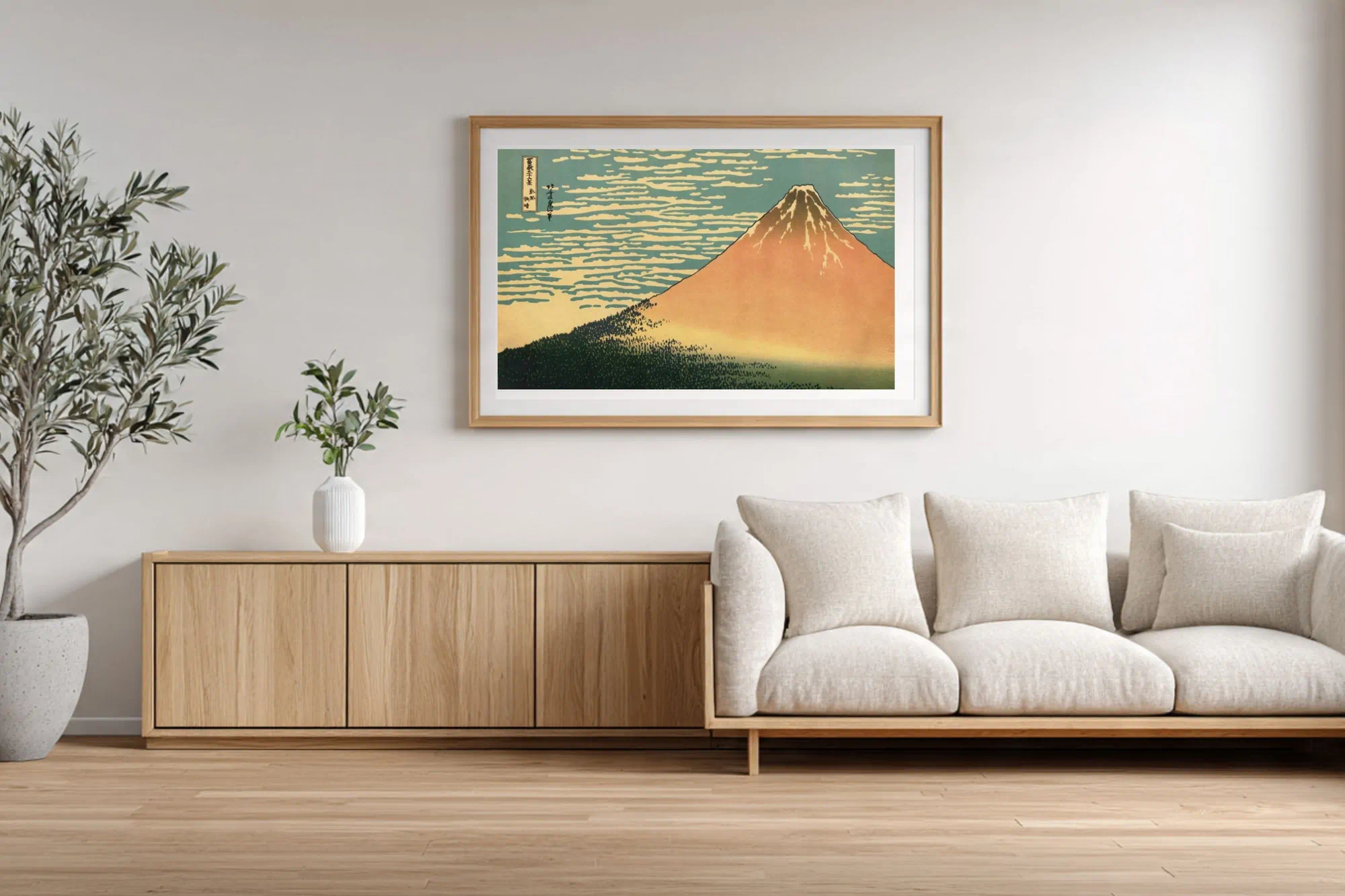
No mountain in human history has been painted as many times as Mount Fuji. In the late 18th and early 19th centuries alone, it appeared in hundreds of thousands of individually printed woodblock prints — on walls in Edo townhouses, in the portfolios of samurai, in the homes of merchants across Japan. It was Japan’s sacred peak, its north star, its most recognizable symbol, and one of the most productive subjects in the history of commercial art. The story of Mount Fuji in Japanese woodblock prints is inseparable from the story of how Japan understood itself.
This article is a complete visual guide to that story — why Fuji dominated the woodblock print tradition, which artists made it famous, and how the mountain looks different in every significant artist’s hands.
Why Is Mount Fuji So Common in Japanese Woodblock Prints?
The question has several answers, operating at different scales. The simplest is geographical: Mount Fuji is visible from a large portion of the Kantō plain, including the city of Edo (Tokyo), on clear days. For residents of one of the world’s largest cities in the early 19th century, Fuji was a constant presence on the horizon — a daily landmark, a visual anchor for the flatlands of the Kantō region.
But geography alone doesn’t explain the intensity of Fuji’s presence in visual art. A mountain visible from a city doesn’t automatically become a subject of artistic obsession. What elevated Fuji was its combination of visual qualities with deep religious and cultural significance.

Fuji as a Sacred Symbol in Edo Culture
Mount Fuji has been a sacred site in Japanese religion for over a millennium. Shinto tradition regards mountains as dwelling places of kami — divine spirits. Fuji, as Japan’s highest mountain, was associated with particularly powerful kami, especially the goddess Konohanasakuya-hime, a deity of the blossoming of life and the volcano’s fire.
Buddhist cosmology had its own mapping onto Fuji: the mountain’s conical form and snow-capped peak resonated with Buddhist concepts of the sacred mountain as a path between earth and heaven. The practice of Fuji-kō (富士講 — Fuji pilgrimage confraternities) spread throughout Edo-period Japan, creating organized networks of pilgrims who climbed the mountain or participated in religious practices in its honor without climbing. At the peak of Fuji-kō popularity in the late 18th century, membership in Edo alone numbered in the hundreds of thousands.
For ordinary Edo citizens who could not travel to climb the mountain, woodblock prints served a quasi-devotional function. A print of Fuji on the wall was a presence of the sacred in daily life. Publishers understood this and marketed Fuji prints accordingly. When Hokusai began his Thirty-Six Views series, he was tapping into a market that was simultaneously aesthetic, cultural, and religious.
The Visual Character of Fuji That Made It Perfect for Prints
From a purely visual standpoint, Mount Fuji is an ideal subject for woodblock printing. Its form is immediately recognizable — a nearly perfect symmetrical cone — which means it reads clearly even when depicted small. It can anchor the background of a composition or dominate the foreground. It changes dramatically with weather, season, and time of day, which means the same subject can yield virtually unlimited compositional variations. And its combination of simple overall form with complex surface details (snow patterns, cloud formations, color changes) suits the woodblock medium perfectly.
The mountain’s profile is so recognizable that Hokusai could reduce it to a tiny white triangle in the upper distance of a composition — as he does in The Great Wave — and it remains instantly identifiable. This visual economy was a compositional advantage that no other subject offered.
The Artists Who Made Fuji Famous
Several major ukiyo-e artists contributed significantly to the visual tradition of Fuji in woodblock prints, but two dominate: Katsushika Hokusai and Utagawa Hiroshige.
Katsushika Hokusai (1760–1849) created the most influential Fuji series: Thirty-Six Views of Mount Fuji (富嶽三十六景, c. 1831–1834) and One Hundred Views of Mount Fuji (富嶽百景, c. 1834). In these series, Hokusai approached Fuji as a conceptual subject — not a portrait of a mountain but a meditation on time, scale, and the relationship between human activity and permanent natural form.
Utagawa Hiroshige (1797–1858) approached Fuji differently: as a feature of specific landscapes, encountered at specific moments in travel. His series Fifty-Three Stations of the Tōkaidō (東海道五十三次, 1833–1834) includes numerous views of Fuji seen along the major road connecting Edo and Kyoto. His Fuji is atmospheric — often glimpsed through rain, mist, or falling snow. Where Hokusai’s Fuji is bold and structural, Hiroshige’s is lyrical and sometimes melancholic.
Mount Fuji in Japanese Woodblock Prints: Five Must-Know Works
The following five works represent the range and depth of Fuji’s presence in the woodblock print tradition.
Hokusai’s Great Wave: Fuji as the Still Center
The Great Wave off Kanagawa (神奈川沖浪裏, c. 1831) is the most famous work in the entire Fuji tradition — and one of the paradoxes of its fame is that Fuji is not the visual focus. The mountain appears small and distant, framed by the two curling wave crests, at the compositional center but the visual margin of the image.
This is Hokusai’s philosophical statement: Fuji is eternal and still while everything around it is violent and impermanent. The wave will crash and be gone. The mountain will remain. The tension between the massive wave and the tiny mountain creates the image’s emotional power — and its implicit argument about the relationship between human-scale experience and geological permanence.
Fine Wind, Clear Morning (Red Fuji): Pure Mountain
Fine Wind, Clear Morning (凱風快晴, c. 1831) is the second print in the Thirty-Six Views series and the most direct frontal depiction of the mountain. The composition is audaciously simple: Fuji occupies the upper two-thirds of the frame against a deep blue sky. Its lower slopes are covered in summer green; its upper slopes glow brick red in early morning light.
There are no human figures, no narrative elements, no compositional complexity. Just the mountain and the sky. This directness is its own kind of courage — trusting the mountain to be enough, with no supporting elements. The result is one of the most powerful nature images in Japanese art.
Hiroshige’s Rain at Shōno: Fuji in Weather
Sudden Shower over Shin-Ōhashi Bridge is perhaps Hiroshige’s most technically innovative depiction of weather, and throughout his travel series, Fuji appears in similar atmospheric conditions: rain-streaked, snow-blurred, glimpsed through mist on the horizon. Hiroshige understood that the mountain’s emotional impact was heightened by atmospheric conditions that partially obscure it — the half-seen Fuji is more evocative than the fully revealed one.
This Romantic sensibility — landscape as emotional atmosphere rather than topographical record — made Hiroshige’s approach deeply influential on Western painters. Van Gogh’s famous oil-paint copies of Hiroshige rain scenes show how directly this atmospheric approach translated into European Impressionist sensibility.
Hokusai’s Thunderstorm Beneath the Summit
Rainstorm Beneath the Summit (山下白雨, c. 1831) shows Fuji from the west, with a violent thunderstorm occurring on the mountain’s lower slopes while the upper peak remains clear above the storm clouds. Lightning is implied in the dark atmosphere; the storm is visible as a churning black-and-blue mass at the mountain’s mid-section.
This image plays with the literal altitude of the mountain — it’s so tall that its summit is above the weather systems that strike its lower slopes. This is meteorologically accurate: Fuji’s summit is frequently clear while storms rage below. Hokusai was depicting a real phenomenon, but he used it for maximum dramatic effect.
Night Views and Lesser-Known Masterpieces
Among the 46 prints of the Thirty-Six Views, several night scenes and unusual-angle compositions deserve more attention than they typically receive. Mount Fuji Reflected in Lake Kawaguchi shows the mountain’s perfect cone mirrored in still water — a doubled Fuji, one rising and one descending, the two halves of a visual symmetry that would not look out of place in a contemporary minimalist design context.
Fuji from Mishima Pass shows the mountain’s base rather than its peak as the compositional subject — a choice so unusual that it initially surprises the viewer, who expects to see the iconic cone. Instead, we’re positioned at the base, where Fuji’s presence is felt in the scale of the trees at its foot and the sense of mass pressing down from above.
How to Identify Authentic vs. Reproduction Prints
As interest in historical Japanese woodblock prints has grown, the market has expanded with it — and so has the number of reproductions, modern facsimile editions, and outright forgeries. For collectors considering authentic period prints, here are key indicators of authenticity:
| Feature | Authentic Period Print | Modern Reproduction |
|---|---|---|
| Paper | Hand-made washi with visible fibers; slightly uneven thickness | Machine-made; uniform thickness; sometimes overly white |
| Ink texture | Slightly raised under magnification; ink absorbed into paper | Flat; often has dot pattern under magnification (halftone) |
| Color | May show some fading, particularly blues | Often too vivid or too uniform |
| Edges | May show block edge impressions; irregular trimming | Perfect trimming; no block impressions |
| Seals/signatures | Publisher and censor seals visible; artist signature carved | Often missing or added by hand |
Major auction houses with specialist Japanese art departments (Christie’s, Sotheby’s, Bonhams) regularly offer authenticated period prints. Museum deaccessions and specialist dealers are other reliable sources. Prices for authentic Hokusai and Hiroshige prints range from a few hundred dollars for common later-edition prints to many millions for rare first editions in exceptional condition.
The Digital Legacy of Fuji in Japanese Woodblock Prints
The visual tradition of Mount Fuji in Japanese woodblock prints has found a new life in the digital age. High-resolution digitization of museum collections has made the full range of Hokusai and Hiroshige’s Fuji imagery accessible to anyone with an internet connection. Contemporary artists and designers draw on this tradition directly — sometimes as homage, sometimes as transformation, sometimes as pure aesthetic resource.
The visual conventions Hokusai established for depicting Fuji — the contrasting scales, the atmospheric effects, the mountain as witness to human activity — continue to appear in contemporary Japanese graphic design, advertising, and popular culture. The mountain is as visually present in modern Japan as it was in Edo, and the woodblock print tradition remains the primary visual language through which that presence is expressed.
Summary: Mount Fuji in Japanese Woodblock Prints and Their Digital Legacy
The story of Mount Fuji in Japanese woodblock prints is ultimately a story about visual language and cultural identity. Hokusai and Hiroshige transformed a sacred mountain into a visual vocabulary — a set of compositional conventions, color approaches, and philosophical stances toward landscape that became foundational for Japanese visual culture and then, through Japonisme, for Western modern art as well.
Every time you see Fuji’s perfect cone in a woodblock print, you’re looking at a mountain that has been observed, interpreted, and reinterpreted by generations of artists — each adding their own understanding to a tradition that keeps accumulating depth without losing clarity. That’s what a great subject does: it supports the weight of endless attention without collapsing under it.
✦ Own This Tradition — In High Resolution ✦
ZenLine Atelier’s digital prints bring Mount Fuji home in the way Hokusai intended — vivid colors, clear detail, the original Prussian blue restored. Instant download, wall-ready at any size.