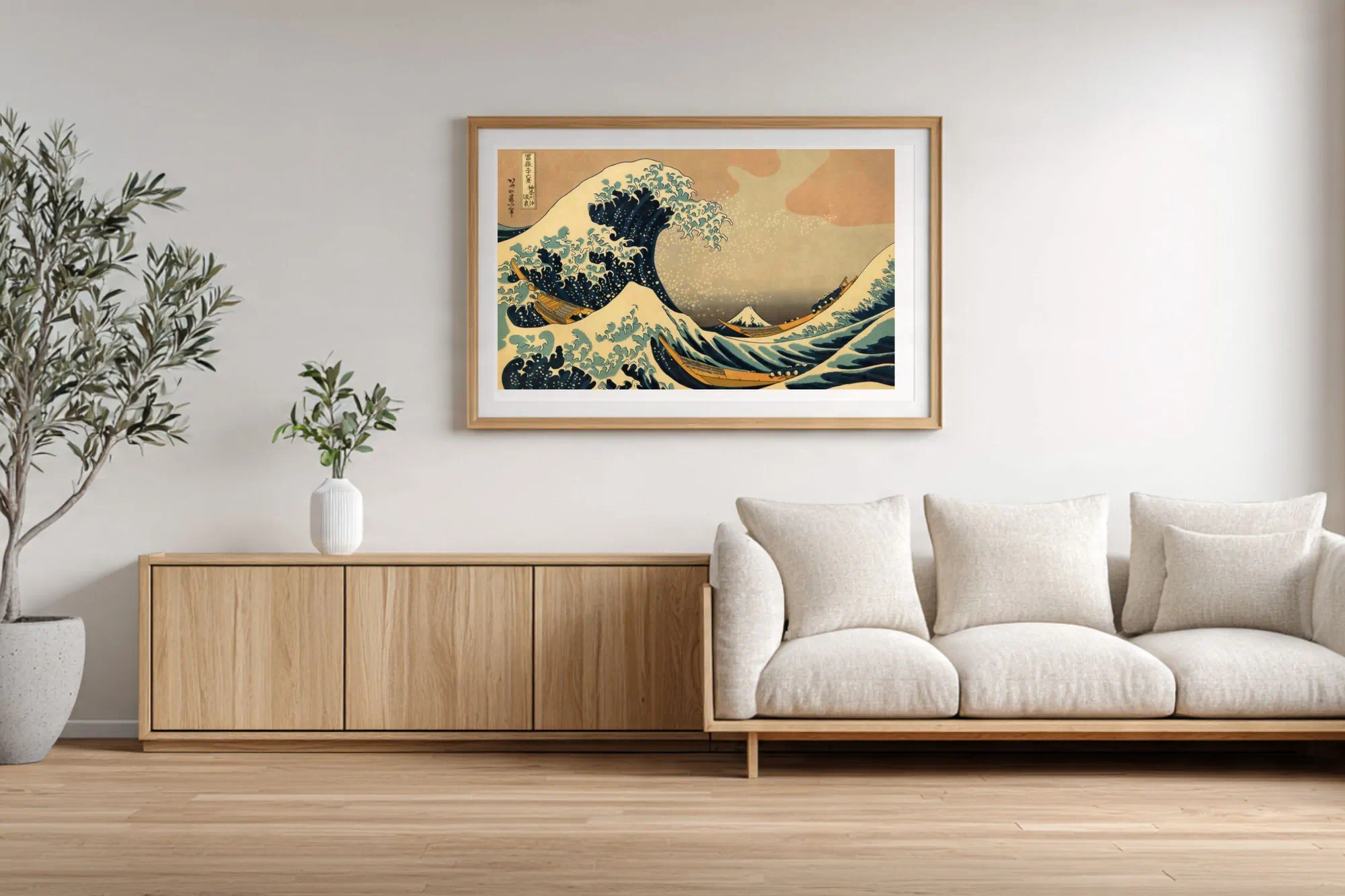
Most people know him as Hokusai. But the man behind The Great Wave had more identities than almost any artist in history. If you’ve ever asked yourself how many names did Hokusai have, you’re about to discover something extraordinary: this legendary Japanese master changed his name over 30 times throughout his life — and each name change tells a story.
This wasn’t vanity or confusion. In Edo-period Japan, an artist’s name was a declaration of purpose, a marker of transformation, a public announcement of reinvention. For Hokusai, renaming himself was as natural as picking up a new brush. Understanding each name reveals the full arc of a man who spent 90 years relentlessly chasing perfection.
In this article, we’ll walk through his most significant aliases, decode what they mean, and explore the philosophy that drove one of the world’s greatest artists to keep rewriting his own story.

Why Did Japanese Artists Change Their Names So Often?
Before we count how many names Hokusai had, we need to understand the system that made it normal — even expected — for an artist to carry multiple identities.
In Edo-period Japan (1603–1868), professional artists operated within a complex social hierarchy of schools, masters, and apprentices. When a student entered a school, they often received a gō (artistic pseudonym) from their master. As they progressed, they earned new names. When they left a school, they left the name too — or sometimes kept it as a foundation for a new identity.
Artists also used different names for different types of work. A painter might use one name for formal commissions and another for playful sketches. Publishers sometimes assigned pen names to specific series. And name changes could mark life events: a move to a new neighborhood, recovery from illness, a fresh creative direction, or simple desire for a new beginning.
For Hokusai, all of these reasons applied at different times. But his name changes were also unusually personal — almost obsessive. He seemed to believe that a new name could unlock a new way of seeing.
The Edo Name System: Gō, Myōseki, and Haimyō
Japanese artists typically carried several types of names simultaneously. A gō (号) was an artistic sobriquet — freely chosen and often poetic. A myōseki was an inherited studio name, passed from master to student. A haimyō was a haiku pen name used in literary circles. Hokusai was active in all three worlds — visual art, illustration, and poetry — so he accumulated names from multiple directions.
His birth name was Tokitarō (時太郎), given to him around 1760 in the Honjo district of Edo (modern Tokyo). He would carry this name until his early teens, when he was apprenticed to a wood-block engraver and began his formal artistic life.
Apprenticeship and the First Studio Names
Around age 12, young Tokitarō began working at a lending library, developing his love of books and illustration. By his mid-teens, he entered the workshop of wood-block engraver Sōjirō. Here, the process of professional renaming began.
At approximately 18, he became a pupil of the celebrated Utagawa school master Katsukawa Shunshō. Upon entering the school, he was given the name Shunrō (春朗 — “Spring Brilliance”). This was standard practice: students of Katsukawa Shunshō all began their names with the character “Shun” (春, spring). Under this name, he produced his first published works: actor portraits in the Katsukawa style.
As Shunrō, he was prolific and promising. His early prints show the confident line work and dramatic expressions typical of Katsukawa-style yakusha-e (actor portraits). But even at this early stage, he was pushing boundaries. He experimented with landscapes and comic illustrations — genres outside the Katsukawa school’s focus — and this led to tension with his fellow students.
How Many Names Did Hokusai Have — The Complete Accounting
After leaving the Katsukawa school in the late 1780s (reportedly expelled or frozen out for his independent experiments), Hokusai entered one of the most turbulent and creatively explosive periods of his life. This is where the name changes accelerate.

Sōri: The Tawaraya Influence
After parting ways with the Katsukawa school, Hokusai studied briefly under Tawaraya Sōtatsu‘s stylistic successors and the Rinpa school tradition. He adopted the name Sōri (宗理), working extensively in the delicate surimono format — small, privately commissioned prints featuring poetry and illustration for elite literary circles.
The Sōri period (roughly 1795–1798) shows Hokusai at his most refined and elegant. His surimono from this era are among the most sought-after in the world. Interestingly, he eventually passed the name “Sōri” on to a student, as was traditional — a gift of identity, not a loss of one.
The Birth of “Hokusai”
Around 1798, the artist adopted the name that would eventually make him immortal: Hokusai (北斎). The name means “Studio of the North Star” — Hoku (北) means north, and sai (斎) means studio or study. The name has Buddhist connotations as well: the North Star was associated with the Bodhisattva Myōken in Japanese esoteric Buddhism, a deity of the celestial north who represents unchanging guidance.
It was under variations of the Hokusai name — Hokusai Tomiza, Hokusai Kako, Hokusai Taito — that he would produce some of his greatest work. But he would still change the name many more times.
Taito: The Bold Claim
Around 1811, Hokusai adopted the name Taito (戴斗 — “Wearing the Big Dipper”). This was an unusually grand claim: the Big Dipper is a major constellation, and the name implied cosmic ambition. Some scholars interpret it as a statement that his art was as vast and inescapable as the stars themselves.
The Taito period aligns with the publication of the first volumes of Hokusai Manga — his massive illustrated encyclopedia of the world. During this time he was at peak productivity, filling sketchbooks with thousands of drawings ranging from mythological creatures to everyday Edo street scenes.
As with Sōri, he later gave the name Taito to a student, a practice he would repeat. Each passed-on name carried his legacy forward, multiplying his artistic lineage.
Iitsu: The “Once Again” Painter
Around 1820, Hokusai took the name Iitsu (為一 — roughly “one for all” or “the one”). This is the name under which he created the Thirty-Six Views of Mount Fuji series, including The Great Wave and Fine Wind, Clear Morning (Red Fuji). In other words, the most famous artworks in Japanese history were signed with a name most people have never heard.
The Iitsu period (c. 1820–1834) represents the absolute pinnacle of his creative output. He was in his 60s, supposedly past his prime by conventional standards, yet producing work of breathtaking originality and technical mastery.
Gakyō Rōjin Manji: The Mad Old Man
From around 1834 until his death in 1849, Hokusai used his final and perhaps most extraordinary name: Gakyō Rōjin Manji (画狂老人卍 — “The Old Man Mad About Painting”). The swastika character manji (卍) in the name is a traditional Buddhist symbol of eternity and good fortune in Japanese culture, representing his wish to keep painting forever.
Under this name, Hokusai produced the series One Hundred Views of Mount Fuji (富嶽百景) and continued working right up to the end of his life. In a famous letter written near the end of his life, he wrote: “If only heaven will give me just another ten years… just another five more years, I will be able to become a real artist.”
He died in 1849 at age 89 (some sources say 90). He had been painting, in various identities, for over 70 years.
The Full List of His Most Significant Names
| Name | Period | Meaning | Key Works |
|---|---|---|---|
| Tokitarō | Birth–c.1778 | Birth name | — |
| Shunrō | c.1779–1794 | “Spring Brilliance” | Early actor prints |
| Sōri | c.1795–1798 | Rinpa lineage name | Surimono prints |
| Hokusai | c.1798–1811 | “Studio of the North Star” | Early landscapes |
| Taito | c.1811–1820 | “Wearing the Big Dipper” | Hokusai Manga |
| Iitsu | c.1820–1834 | “One for all” | 36 Views of Fuji, The Great Wave |
| Gakyō Rōjin Manji | c.1834–1849 | “Old Man Mad About Painting” | 100 Views of Fuji |
In total, scholars have documented between 30 and 36 distinct names used by the artist at various points in his life. Some were used only briefly; others lasted for decades. Some were passed on to students; others died with him.
Names as Milestones of Reinvention
What’s remarkable about Hokusai’s name changes is not their number, but their intentionality. He wasn’t running from his past — he was consciously shedding old skins to force himself forward. Changing a name, in his view, was changing a perspective. A new name meant new eyes.
This belief is echoed in Japanese Zen philosophy, where the concept of shoshin (初心, “beginner’s mind”) is central: to see everything fresh, without the weight of habit. Each of Hokusai’s new names was, in a sense, an attempt to recover beginner’s mind at a higher level of skill.
The Student Names He Gave Away
Hokusai’s generosity with names is striking. He passed on “Sōri,” “Taito,” and possibly others to students who carried those artistic lineages forward. This was a significant gift — a student receiving a master’s name gained immediate credibility and a ready-made artistic identity. It also meant Hokusai had no attachment to the names as possessions. They were tools, not trophies.
Some of his students built entire careers under names Hokusai had discarded. This network of name-sharing created a kind of artistic family tree rooted in his identity, spreading his influence far beyond his own output.
Why “Hokusai” Stuck to History
Of all his names, “Hokusai” is the one history chose. He used it from around 1798 onward in various compound forms — and even after formally switching to Iitsu and then Manji, he often still wrote “Hokusai” as a secondary identifier on prints.
Western art historians and collectors who began encountering his work in the 19th century latched onto “Hokusai” as the most recognizable name. By the time Japonisme swept through Europe in the 1860s–80s, “Hokusai” was already the internationally recognized label. History simplified the man, but the man had always been more than one name could hold.
Summary: How Many Names Did Hokusai Have — And Why It Matters
The answer to how many names did Hokusai have is: at least 30, possibly more. But the more important answer is why he changed them so often. Each name was a reinvention. Each reinvention pushed his art further. The result was a body of work — spanning over 30,000 individual drawings, prints, and paintings — produced across seven decades under dozens of names, unified by one relentless vision.
Hokusai was not trying to be remembered. He was trying to keep growing. The names were breadcrumbs he left behind, marking the path of a man who never stopped beginning again.
✦ Experience Hokusai’s Vision Reborn ✦
Our digital art prints at ZenLine Atelier restore Hokusai’s original colors — stripping away the printer’s haze to reveal the clear sky he actually painted. Instant download. Print at any size.