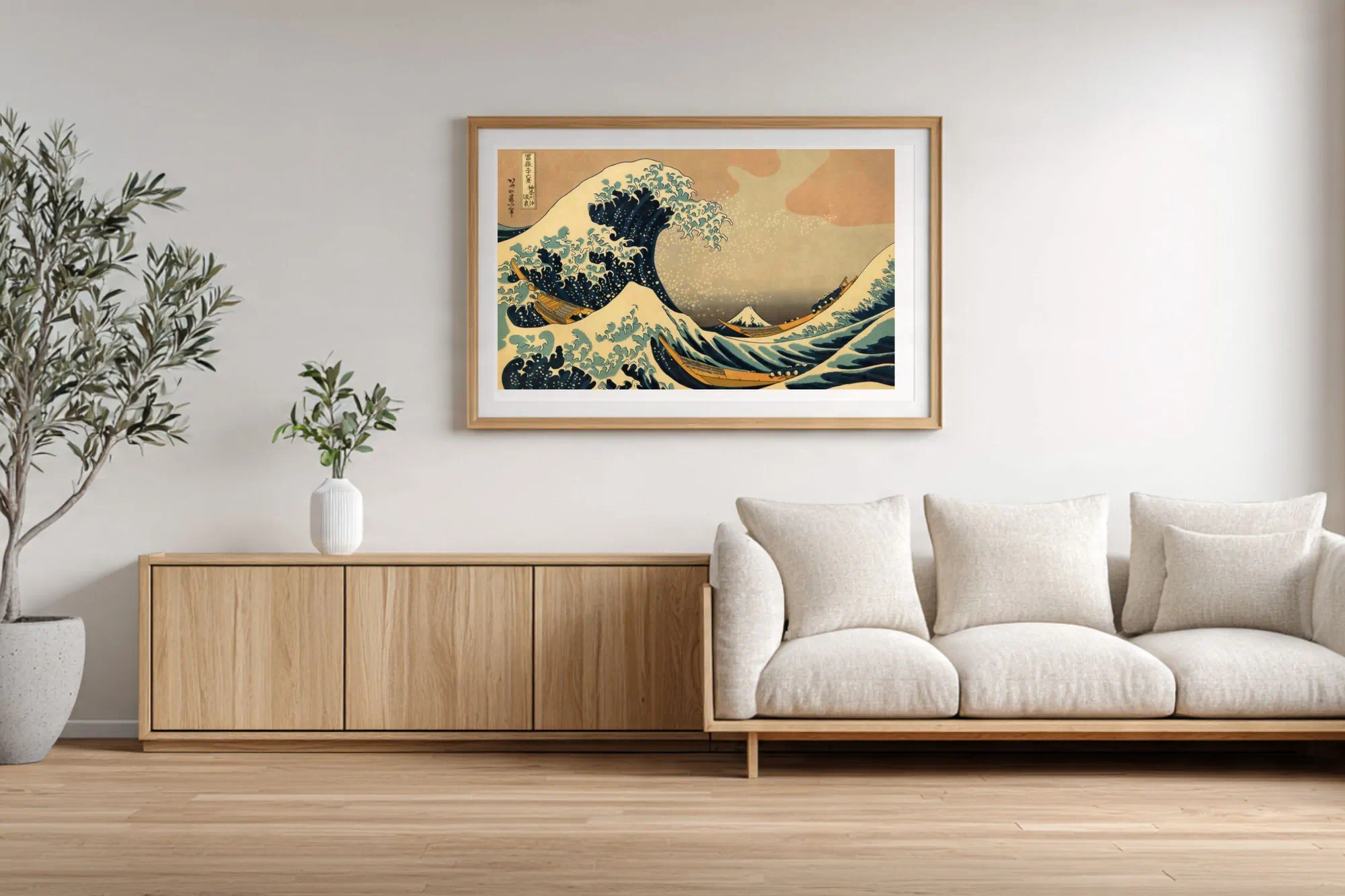
It’s the most famous wave in history. More people have looked at it than any other image of the sea. And yet most of us have never stopped to ask the obvious question: how big is Hokusai’s wave in real life? If that wave were a real ocean wave, how tall would it be? Would it be physically possible? And what does the math reveal about what Hokusai was actually painting?
These questions sit at an unusual intersection of art history, physical oceanography, and compositional geometry. The answers are surprising — and they reveal that Hokusai was a far more precise observer of natural phenomena than the mythological grandeur of the image suggests.
What Is Hokusai’s Wave and Why Do We Care About Its Size?
The Great Wave off Kanagawa (神奈川沖浪裏) was designed by Katsushika Hokusai and published around 1831 as the first print in his series Thirty-Six Views of Mount Fuji. It depicts a large wave in the foreground with three small boats visible beneath it, and Mount Fuji visible in the distance at reduced scale.

The size question matters for several reasons. First, it tells us whether Hokusai was painting a realistic wave or a fantastical one. Second, it helps us understand the boats and their occupants in relation to the scene. Third — and most intriguingly — it intersects with modern oceanographic research into “rogue waves,” extreme wave events that were dismissed as sailor’s myth until the late 20th century definitively confirmed their existence.
Hokusai Wave Size Real — What Scientists Estimate
Several researchers have attempted to calculate the wave’s size using the available compositional references.
The most useful reference point is the boats. The vessels depicted are oshiokuri-bune — fast courier boats used to transport fresh fish to Edo’s markets. Historical records indicate these boats were typically 12 to 15 meters long (approximately 40–50 feet). Working from this baseline, researchers have made the following calculations:
- The boats in the image appear approximately 1/6 to 1/8 the length of the wave’s horizontal span at its base
- If the boats are ~12–15 meters, the wave base spans approximately 72–120 meters
- The wave height, from its base to its crest, appears approximately 1/2 to 2/3 of its horizontal span
- This yields a wave height estimate of approximately 10–20 meters (33–66 feet)
This range is striking: it places the wave firmly within the documented range of real extreme ocean waves. A 10–20 meter ocean wave is extraordinary — most open ocean waves are 2–4 meters — but not physically impossible. Large storm waves regularly reach this range, and rogue waves (more on these below) have been measured at heights exceeding 25 meters.
Rogue Waves: Are Waves Like This Actually Possible?
Until the 1990s, the oceanographic community was skeptical of reports of extreme waves in open ocean — waves that appeared suddenly, far exceeded surrounding wave heights, and sometimes reached towering proportions. Such waves were described in countless sailor accounts across many centuries, but they were dismissed as exaggeration or myth.
That changed on January 1, 1995, when a rogue wave was recorded by instruments on the Draupner oil platform in the North Sea. The wave was approximately 25.6 meters tall — roughly 84 feet — while surrounding waves averaged 12 meters. This was the first definitive scientific measurement of what is now called a “rogue wave” or “freak wave.”
Subsequent research has documented rogue waves occurring with much greater frequency than previously assumed. Satellite data analysis in the early 2000s identified dozens of rogue waves over a three-week measurement period. These waves appear to form through a process of wave constructive interference, where multiple wave systems converge and their energies combine, producing a momentary peak that can exceed three times the significant wave height of surrounding seas.
The implications for Hokusai’s wave are interesting. At the estimated 10–20 meters, The Great Wave falls within the range of real, documented extreme waves. Hokusai may not have been painting a mythological impossibility — he may have been painting, with artistic amplification, a real phenomenon that he or people he knew had witnessed.
The Math Behind The Great Wave’s Proportions
The second major scaling problem in the composition is Mount Fuji. In the print, Mount Fuji appears as a small, white triangular form in the upper center of the frame — roughly the same height as the wave crest, suggesting it’s at about the same visual scale.
Here the math becomes impossible. Mount Fuji is 3,776 meters tall (12,389 feet). If the wave’s crest appears at approximately the same scale as Mount Fuji in the composition, and if we use the wave-as-20-meters calculation, then Fuji would need to be approximately 200 times larger in reality than the wave — which it is. The visual equivalence between wave crest and mountain height in the composition is therefore a deliberate impossibility, a compression of scale that Hokusai used to create his emotional effect.
He was not trying to say the wave was as tall as Fuji. He was using compositional perspective to create a specific emotional dynamic: the massive, close wave dwarfs the distant, permanent mountain. Impermanence overpowers permanence. The moment overwhelms the eternal. This is the philosophical content of the image, expressed through deliberate geometric manipulation.
Mount Fuji as a Scale Reference: What the Geometry Reveals
Looking more carefully at the geometry of the composition, Hokusai made several specific choices that reveal his visual strategy.
The Position of Fuji in the Frame
Mount Fuji is positioned exactly at the convergence of the two main wave crests. Its peak appears in the “pocket” of negative space between the curling right crest and the rising left crest. This placement is not accidental — it frames the mountain in a moment of visual security, protected by the wave forms, while the boats are being overwhelmed by them.
This geometric relationship suggests a reading of the image as a statement about scale and perspective: from the boats’ position, the wave is everything. From Fuji’s position — distant, stable, permanent — the wave is a small event. The image holds both perspectives simultaneously, inviting the viewer to occupy both positions at once.
The Golden Ratio and Japanese Compositional Geometry
Several analysts have noted that the main compositional elements of The Great Wave align with the golden ratio. The horizon divides the image vertically in approximately a 1:1.618 relationship. The wave crest positions align with similar proportional divisions horizontally. Whether Hokusai consciously applied golden ratio mathematics (which he would have had access to through imported European scientific texts) or arrived at these proportions through visual intuition, the result is a composition with the geometric coherence of classical architecture.
Japanese compositional theory, particularly as transmitted through Chinese painting manuals available in Edo, also emphasized specific geometric relationships in landscape composition. The relationship between near and far, large and small, moving and still — all were prescribed in compositional guides that Hokusai would have studied. His print works within and then transcends these conventions.
The Boats: Their Size, Crew, and Relationship to the Wave
Returning to the boats: the oshiokuri-bune typically carried crews of 8–12 men. In the print, the figures are visible as small shapes crouching in the hull — almost entirely below the gunwale, suggesting they’ve seen the wave and are taking the only survival posture available: getting low and holding on.
The boats are arranged in three groups across the composition. The two nearest boats are nearly vertical, their prows lifted by the oncoming wave, while the third is visible in the lower center between the two wave crests. The three boat positions track a narrative arc: approaching, in the grip of, and — perhaps — surviving.
At the estimated scale, even a 15-meter wave would be a life-threatening event for a 12-meter boat. The crew’s survival posture is appropriate and realistic. This level of practical naval detail in an otherwise mythologically scaled composition suggests that Hokusai interviewed fishermen or otherwise researched how experienced mariners responded to extreme waves.
What Modern Oceanographers Say About The Great Wave
When physical oceanographer Fredric Choi and colleagues at the University of Southern California analyzed the wave structure of The Great Wave in a 2020 paper, they found that the wave’s morphology — its steep face, curling crest, and pattern of secondary waves in the trough — is consistent with a breaking wave at the moment of maximum steepness, just before the crest overturns.
The paper noted that Hokusai’s representation captured details that are only visible in slow-motion footage of waves — details that the human eye struggles to perceive in real time because they happen so quickly. How did Hokusai render features that even modern observers find difficult to see? The answer is probably iterative observation: spending years watching waves, making quick sketches, refining his understanding of wave morphology print by print across multiple series, until he had internalized the physics deeply enough to render its decisive moment from imagination.
The “claw” formations at the wave tips — which are actually droplets and foam breaking off the crest at the moment of overturning — appear in high-speed photographs of real waves. Hokusai rendered them as dramatic abstract forms, but they’re grounded in observed reality.
Summary: Hokusai Wave Size Real — Art That Holds Up to Science
The answer to “hokusai wave size real” is more interesting than the question implies. The wave, using boats as scale references, is approximately 10–20 meters tall — within the documented range of real extreme ocean waves. Its scale relationship to Mount Fuji is deliberately impossible, a compositional device for philosophical effect. Its structure is consistent with real wave physics at the moment of maximum steepness.
Hokusai was simultaneously a precise observer of natural phenomena and a mythological painter. He used real physical details as raw material for a composition that operates at mythological scale. The wave is real and impossible at the same time — which is exactly what makes it one of the greatest images in art history.
✦ The Wave, Restored to Its Original Blue ✦
ZenLine Atelier’s digital print of The Great Wave restores Hokusai’s original Prussian blue intensity — the unfaded color his Edo audience actually experienced. Instant download, print-ready at any size.