In 1814, a publisher in Nagoya released a small illustrated book that would change the history of visual art — twice. First, it would become the most influential illustrated reference work in Edo-period Japan, copied, studied, and imitated by generations of artists. Second, it would, two centuries later, be discovered by Western scholars and recognized as one of the earliest antecedents of a visual storytelling form that would become a global phenomenon. The Hokusai manga book of 1814 is the origin point of the word “manga” itself — and almost everything about it is more interesting than you’d expect.
What Is the Hokusai Manga Book Published in 1814?
The Hokusai Manga (北斎漫画) is a collection of illustrated sketchbooks designed by Katsushika Hokusai and published between 1814 and 1878 — the final three volumes appearing posthumously after Hokusai’s death in 1849. The first volume, published in Nagoya in 1814, contains approximately 300 individual sketches across 55 pages. By the time the full 15-volume set was complete, it contained approximately 4,000 individual drawings.

The contents range across virtually every subject Hokusai could observe or imagine: humans in dozens of physical activities, animals (domestic, exotic, and mythological), plants, trees, water in every state, architectural elements, supernatural beings, historical scenes, comic figures, calligraphic studies, and abstract patterns. The result is less like a book and more like an encyclopedia — a systematic effort to document and illustrate everything in the observable world.
How “Manga” Got Its Name from Hokusai
The word manga (漫画) was not invented by Hokusai, but his use of it in the title of this work gave it lasting definition. The character 漫 (man) means “random,” “involuntary,” “in spite of oneself,” or “whimsical.” The character 画 (ga) means “picture” or “drawing.” Together, manga roughly means “whimsical pictures” or “random sketches” — capturing the informal, exploratory quality of the work.
The word had appeared earlier in Chinese poetry and in some Japanese texts with related meanings — casual or improvised drawings. But it was Hokusai’s use of the term in his massively influential sketchbook series that fixed its meaning and spread it into common usage. By the mid-19th century, “manga” was being used by other artists to describe informal illustrated works in a similar vein.
The connection to modern manga — Japanese comic books and graphic novels — is real but indirect. When Japanese cartoonists and illustrators of the late 19th and early 20th centuries began developing what would become the modern manga tradition, they worked within a culture that had “manga” as an established word for illustrated drawing. The formal structure and narrative conventions of modern manga developed over decades through different influences — Western political cartoons, early Japanese newspaper comics, wartime government illustrated publications, and post-war American comics — but the word itself traces a direct etymological line back to Hokusai’s sketchbooks of 1814.
What’s Inside the 15 Volumes
Each volume of the Hokusai Manga is organized thematically, though the organization is loose and the range of subjects is enormous. Subjects across the 15 volumes include:
- Human figures: People walking, sitting, running, sleeping, working, dancing, fighting, eating, bathing. Figures from every social class: samurai, merchants, artisans, farmers, monks, entertainers, children, elderly people.
- Facial expressions: A famous series of pages depicting every conceivable facial expression — grief, joy, surprise, anger, contemplation, laughter — rendered with comic and anatomical precision.
- Animals: Dogs, cats, birds, fish, horses, elephants (based on imported illustrations, as live elephants were extremely rare in Japan), mythological creatures including dragons and phoenixes.
- Plants and natural forms: Trees, grasses, flowers, bamboo, pine trees in every condition and season.
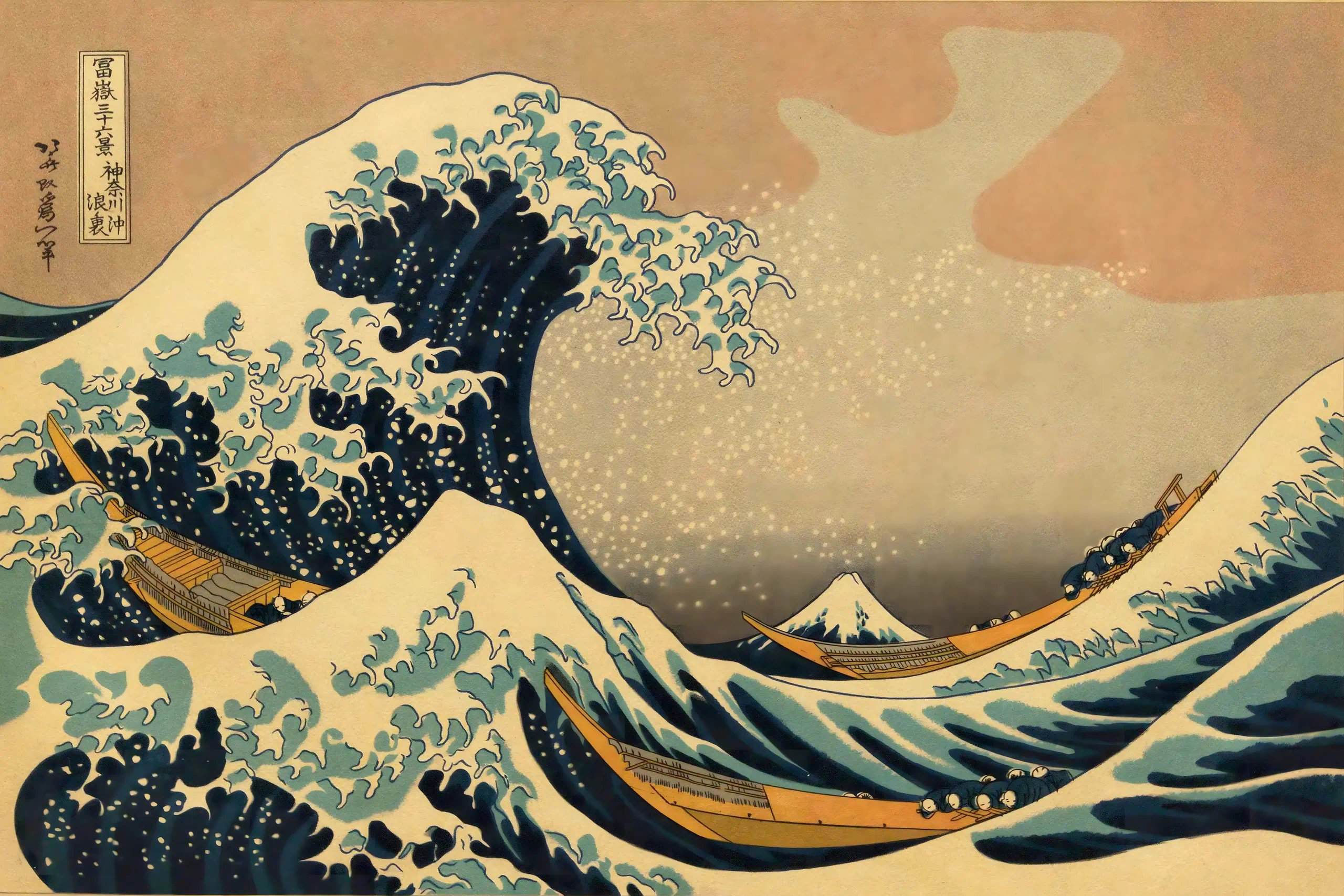
- Water: Ocean waves, rivers, waterfalls, rain, snow, mist — water in every state and form, rendered with the observational precision that would later appear in the Thirty-Six Views series.
- Architectural and decorative elements: Building components, furniture, fabric patterns, ceramic forms, lacquerware designs.
- Supernatural beings: Ghosts, demons, supernatural animals, Buddhist deities, Shinto spirits.
- Comic and grotesque figures: Exaggerated, humorous depictions that verge on caricature — figures with enormous heads, impossible poses, comic expressions.
The sheer catholicity of the content was part of the point. Hokusai was not producing an illustrated book on a specific subject — he was trying to draw the world, in the sense of capturing as much of its visual richness as possible in a systematic form.
Why the Hokusai Manga 1814 Changed Art History
The influence of the Hokusai Manga operated on multiple levels simultaneously: as a practical reference work for working artists, as a commercial sensation that demonstrated the appetite for illustrated educational material, and as a conceptual model for a new kind of visual document.
Its Influence on European Artists: Van Gogh, Monet, and Japonisme
When Japan opened to Western trade and diplomacy in 1854, a flood of Japanese goods and cultural materials entered Western markets. Among the first and most enthusiastically received were ukiyo-e woodblock prints — and among the ukiyo-e materials that captured Western attention was the Hokusai Manga.
The French artist Félix Bracquemond is often credited with “discovering” Japanese woodblock prints in the 1850s, when he encountered pages of the Hokusai Manga being used as packing material around imported Japanese ceramics. He showed these to colleagues, and the cascade began. The movement known as Japonisme — the deep influence of Japanese visual art on European artists from the 1860s onward — was substantially sparked by the Hokusai Manga specifically.
Vincent van Gogh was an avid collector of Japanese prints and copied several of them directly in oil paint. His letters to his brother Theo are full of references to Japanese art. He admired in particular the confident, non-shaded line work and the bold compositional choices he saw in ukiyo-e — qualities the Hokusai Manga exemplified.
Claude Monet’s collection of Japanese prints — now preserved in his house at Giverny, now a museum — included multiple ukiyo-e works and was a significant source of visual inspiration. The flat, decorative quality of Japanese print design influenced his approach to color and surface in the water lily series.
Edgar Degas studied Japanese compositional conventions extensively, particularly the use of asymmetric cropping, unusual viewpoints, and figures cut off by the frame edge — all conventions that appear throughout the Hokusai Manga.
How It Inspired Modern Japanese Manga
The direct lineage from the Hokusai Manga to modern Japanese manga is etymological rather than formal — the word, not the form, is the inherited element. Modern manga as a narrative visual medium developed primarily through the work of post-World War II artists, particularly Osamu Tezuka, who synthesized Japanese illustration traditions with influences from American animation and comics.
However, certain formal qualities of the Hokusai Manga do appear in the broader tradition of Japanese illustrated books from which modern manga emerged. The emphasis on expressive figure drawing, the use of sequential images to convey action and time, the integration of text and image, and the commitment to a wide social range of subjects — all of these qualities connect the Hokusai Manga to the longer tradition within which modern manga developed.
Japanese manga artists themselves generally acknowledge Hokusai as a cultural ancestor — not in the sense of direct artistic influence, but as the originator of the word and as an exemplar of the ambitious illustrated book tradition that makes manga culturally legible in Japan in a way it isn’t quite anywhere else.
Where to See Original Copies Today
Original first-edition volumes of the Hokusai Manga are held in collections at:
- The British Museum, London (one of the largest collections of ukiyo-e outside Japan)
- The Museum of Fine Arts, Boston
- The Metropolitan Museum of Art, New York
- The Rijksmuseum, Amsterdam
- The National Diet Library, Tokyo
- The Tokyo National Museum
Many of these institutions have digitized their holdings, and high-resolution scans of multiple volumes of the Hokusai Manga are available online through institutional digital archives. The complete text is also in the public domain, so reprints and facsimile editions are widely available.
For visitors to Japan, the Sumida Hokusai Museum in Tokyo (opened 2016) maintains a permanent collection focused on Hokusai’s work and context, including materials related to the Manga series. The museum is located in Sumida, the area of Tokyo (then Edo) where Hokusai spent much of his working life.
The Manga as a Teaching Tool: How Hokusai Used It
One important aspect of the Hokusai Manga that is often overlooked: it was designed in part as a teaching resource for students of drawing. Hokusai ran an art school, and his students needed model drawing references — the Manga provided them. Many pages are structured around a single subject approached from multiple angles or in multiple conditions, providing the student with a systematic visual vocabulary.
The page layouts often arrange drawings in a densely packed grid, maximizing the number of examples per page. This density — sometimes 10–20 small drawings per page — creates an almost data-visualization quality: the page becomes a taxonomy of poses, expressions, or natural forms.
Summary: Hokusai Manga 1814 — A Book That Invented a Genre
The Hokusai manga book of 1814 is more than an art historical curiosity. It’s a document of encyclopedic ambition, a teaching resource of extraordinary range, the origin point of an important word in global visual culture, and a spark for one of the most significant cross-cultural artistic exchanges of the 19th century. Its influence extended from the sketchbooks of Van Gogh to the publishing houses of contemporary Tokyo.
Start with a few pages — the facial expression studies, or the wave sequences. Then keep going. There’s always something else on the next page that will stop you.
✦ From Hokusai’s Sketches to Your Walls ✦
ZenLine Atelier brings the refined product of Hokusai’s extraordinary sketchbook practice — the final masterworks — into high-resolution digital format for your home. Instant download.