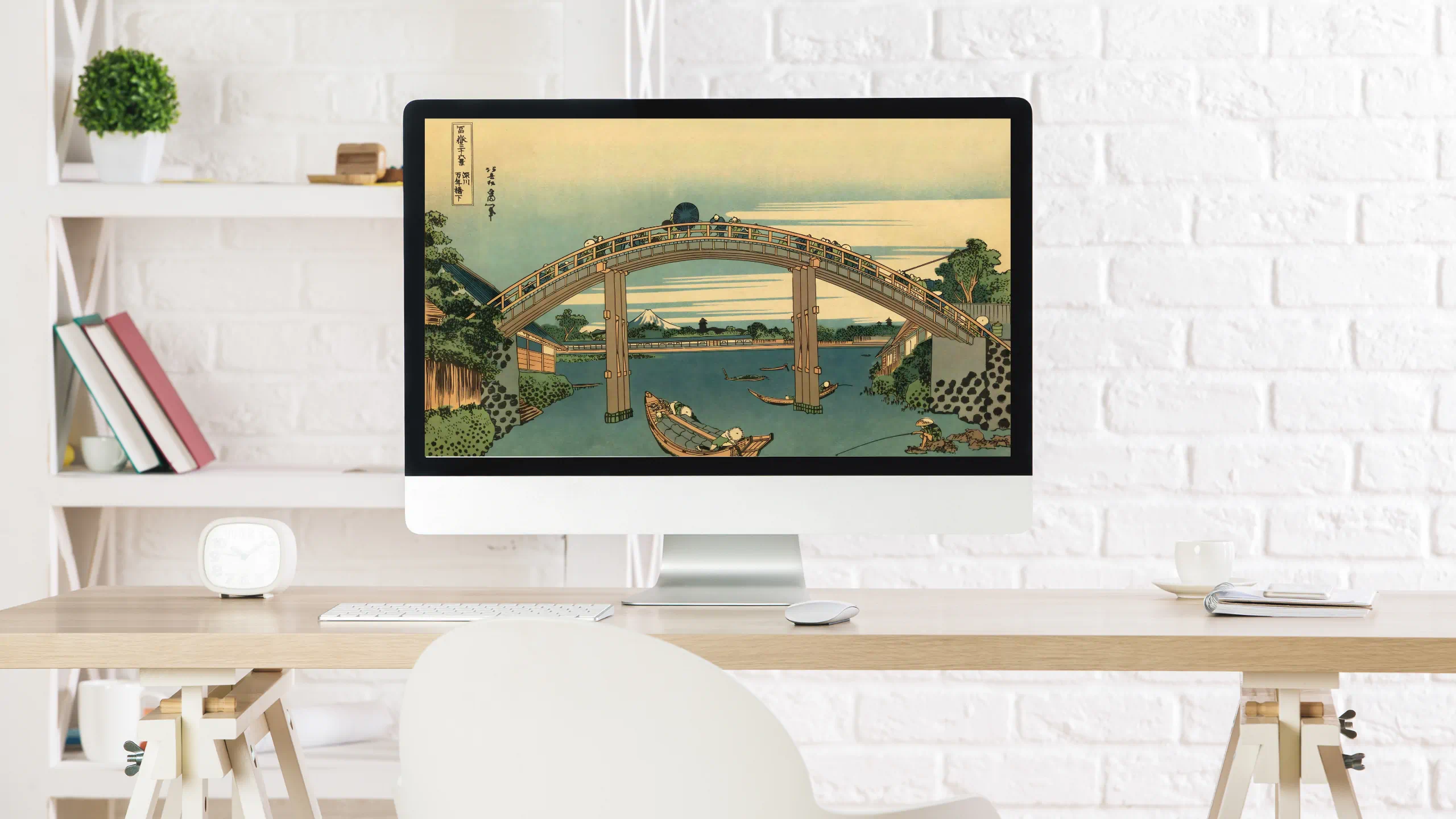
He never stopped. That’s the most remarkable thing. Hokusai died at what age is a question that has a precise answer — he was 89 or 90 years old, depending on how you count in the traditional Japanese calendar — but the number alone doesn’t capture the reality. He was still working. Still experimenting. Still convinced that his best paintings were ahead of him, not behind.
In a famous statement made near the end of his life, he said: “If only heaven would give me just five more years, I could become a real artist.” This from a man who had already produced more than 30,000 drawings, prints, paintings, and illustrated books over the course of seven decades. What does it mean to hunger for artistic growth so deeply that 30,000 works feel like preparation rather than achievement?
This article traces the final arc of Hokusai’s extraordinary life — from his most productive decade in his 60s and 70s, through his remarkable late-period work in his 80s and 90s, to his death in 1849 and the enduring questions it raises about creativity, age, and what art can aspire to.

Hokusai Died at What Age — The Basic Answer
Katsushika Hokusai was born in the 10th lunar month of 1760 (approximately October–November by the Western calendar) in the Honjo district of Edo (modern-day Tokyo). He died on the 18th day of the 4th month of the year Kaei 2 — which corresponds to May 10, 1849, in the Western calendar.
By Western reckoning, he was 88 years old at the time of his death. By the traditional Japanese counting system (kazoedoshi), which considers a person to be one year old at birth and adds a year at each New Year, he was 90. Most Western sources cite his age as either 88 or 89, with some saying “approximately 90.” The figure 90 is conventional in Japanese sources.
Whatever the precise count, he was a very old man by any standard — and one of the most productive old men in art history.
His Life Timeline from Birth to Death
| Period | Age | Key Events |
|---|---|---|
| 1760–1778 | Birth–18 | Born in Edo; works at lending library; apprenticed to engraver |
| 1778–1794 | 18–34 | Studies under Katsukawa Shunshō; produces actor prints as “Shunrō” |
| 1794–1804 | 34–44 | Leaves Katsukawa school; studies multiple other styles; adopts name “Hokusai” |
| 1804–1820 | 44–60 | Fame as illustrator; begins Hokusai Manga series; name “Taito” |
| 1820–1834 | 60–74 | Peak fame; 36 Views of Mount Fuji including The Great Wave; name “Iitsu” |
| 1834–1849 | 74–89 | 100 Views of Fuji; continued painting; name “Gakyō Rōjin Manji”; death 1849 |
What He Was Working on in His 80s and 90s
The conventional narrative of artistic biography places a great artist’s peak work in the middle decades of life and treats old age as decline. Hokusai refuses this narrative almost entirely.
In his late 70s and 80s, working under the name Gakyō Rōjin Manji (“The Old Man Mad About Painting”), he produced the series One Hundred Views of Mount Fuji (富嶽百景, Fugaku Hyakkei), published in three volumes beginning around 1834. Many art critics consider this series even more inventive than the more famous Thirty-Six Views — the compositions are bolder, the perspectives more unusual, the treatment of space and atmosphere more sophisticated.
He also produced large-scale paintings on paper, some of enormous dimensions, for temple commissions and private patrons. A painting of a dragon commissioned for a temple in Obuse — which he traveled to complete at age 83, despite frail health — covers multiple sliding panels and shows technical command that most artists would be proud of in their prime years.
In his 80s, he also produced a series of paintings of birds, flowers, and natural subjects in a style influenced by Chinese ink painting — a deliberate late-career expansion of his visual language into a mode he hadn’t fully explored before. At an age when most painters would be refining existing approaches, Hokusai was still learning new ones.
The Last Words of Hokusai
The most famous document of Hokusai’s final years is a statement attributed to him near the end of his life, recorded by his contemporaries. The exact wording varies across different sources, but the essential content is consistent:
“If only heaven will give me just another ten years… just another five more years, then I could become a real artist.”
This statement has been interpreted in many ways. Some read it as humble self-deprecation — a great master playing down his own achievement. Others read it as genuine artistic hunger — the statement of a man who could see possibilities in his work that he knew he would not live to realize. Given everything we know about Hokusai’s career and personality, the second interpretation seems more credible.
“If I Had Five More Years, I Could Become a Real Artist”
What could he possibly have meant? A man who had produced over 30,000 individual works across more than 70 years of active artistic practice, who had essentially invented several major sub-genres of Japanese art, who had influenced every major artist of his generation and many of the next — what was he still striving for?
The answer, based on his late work, appears to be: a deeper fusion of observational accuracy with transcendent expression. His late paintings — particularly the bird and flower studies, and the large-scale dragons — show an artist pushing toward a point where every brushstroke is both precisely observed and fully expressive. He was chasing the state that Zen artists call mushin (無心, “no-mind”) — where technical mastery becomes so complete that it disappears, and the painting makes itself.
He was close. His late work is remarkable. But he could see the gap between where he was and where he wanted to be — and that gap, small as it may have been, was still real to him. This is what artists who are still genuinely growing experience: the clearer you can see the ideal, the more sharply you feel the distance from it, even as you approach it.
His Funeral and Legacy in Edo
Hokusai died in the spring of 1849 at his home in the Asakusa district of Edo. He was attended by his daughter Oi, who had been his companion and studio assistant for decades. He had reportedly been ill for some time — contemporary accounts mention a fever — but continued working until very near the end.
His funeral was conducted according to Buddhist custom. He was buried in the Seikyo-ji temple in Asakusa, where his grave can still be visited today. He died using the posthumous Buddhist name Nansō-i Gakyōjin — “The Painting-Obsessed One of the Southern Window Hermitage.”
Even in death, the identity he had constructed for himself — the mad old man, the one who could not stop painting — was preserved and honored.
His death was noted in Edo cultural circles but did not generate the kind of immediate, widespread mourning that might be expected for a figure of his stature. The full recognition of his international importance came later, primarily through the Japonisme movement of the 1860s–80s, when Western artists became captivated by Japanese woodblock prints. By then, Hokusai had been dead for nearly two decades — but his prints were everywhere in European studios, transforming the work of painters who would never know his name.
Why He Matters More Today Than He Did in His Own Lifetime
During his lifetime, Hokusai was famous in Edo — one of the most commercially successful print designers of his era. But his fame was largely domestic. His international significance was something that developed after his death, as Japanese art began circulating in Europe and America.
Today, he occupies a place in art history that would have astonished him. The Great Wave off Kanagawa is arguably the most reproduced artwork in history — more widely reproduced than the Mona Lisa, appearing on everything from postage stamps to surfboards to smartphone cases. It has become a global visual icon, recognized by billions of people who have never heard of Edo-period Japan.
The BBC has described Hokusai as one of the most influential artists of all time. His technique of bold flat areas of color, dynamic composition, and dramatic natural subjects directly shaped the development of European modern art. Without Hokusai, it is possible that Impressionism, Post-Impressionism, and Art Nouveau would have developed differently — or more slowly.
Summary: Hokusai Died at What Age — And What He Achieved Before Then
The answer to hokusai died at what age is 89 (or 90 by Japanese reckoning). But the number is almost beside the point. What matters is what he achieved in those years — and what he was still reaching for when they ran out.
He produced more than any comparable artist in history. He changed the visual language of Japan and then, through the global circulation of his prints, changed visual art worldwide. He refused to peak, refused to rest, refused to accept that his best work was already behind him.
His last documented words were a wish for more time to paint. It’s tempting to see this as tragic — the great artist cut off before the finish line. But perhaps it’s the opposite: to be 89 years old, surrounded by 70 years of extraordinary work, and still burning with the desire to make something better — that might be the most complete artistic life it’s possible to live.
✦ Bring the Work of a Lifetime Into Your Home ✦
ZenLine Atelier honors Hokusai’s full 70-year creative arc with restored, high-resolution digital prints — from his bold early compositions to the refined mastery of his final decades.