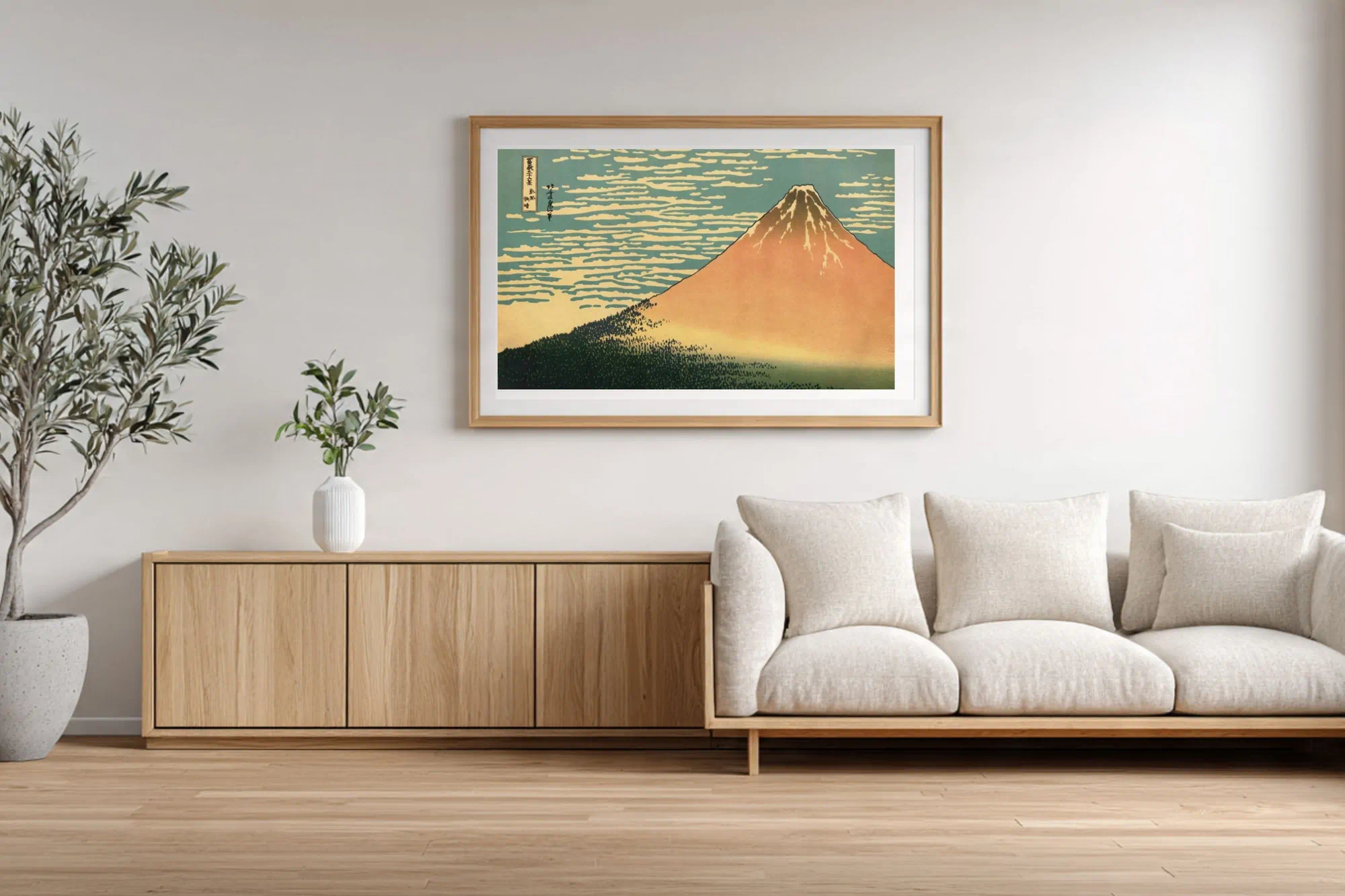
She grew up in her father’s shadow — literally. As a child, she watched Katsushika Hokusai fill sketchbooks by candlelight, moving from one cramped Edo apartment to the next as debt collectors and creditors knocked at their door. She learned to paint almost as naturally as she learned to walk. And yet, for most of art history, Hokusai’s daughter Katsushika Oi was treated as a footnote — mentioned briefly, credited vaguely, and then forgotten.
That is changing. Today, Katsushika Oi is increasingly recognized as one of the most skilled artists of the Edo period in her own right. Her work is being reattributed, her biography pieced together from fragmentary records, and her legacy reclaimed from centuries of deliberate and accidental erasure. This is her story.

Who Was Katsushika Oi, Hokusai’s Daughter?
Katsushika Oi (葛飾応為) was born sometime around 1800 — the exact date is uncertain — as the third daughter of Katsushika Hokusai and his second wife. Her birth name was likely O-Ei, but she adopted the professional name Oi (応為) when she began her artistic career. The name 応為 (Ōi) can be interpreted as “it should be so” or “responding to necessity” — a quietly defiant name for a woman in a society that had very specific ideas about what women should and should not do.
Historical records of her life are sparse. Japanese women of the Edo period rarely left written records, and women who worked as artists were even less documented than their male counterparts. What we know about Oi comes mostly from a handful of contemporary accounts, some art critical writings of the period, and the circumstantial evidence of works that can be attributed to her based on style and studio records.
Growing Up in the Hokusai Studio
Life in the Hokusai household was chaotic by any standard. Hokusai moved over 90 times during his life — according to his own account, he moved whenever a house became “too dirty.” His son Sakunosuke was reportedly irresponsible with money, and Hokusai’s household was frequently in debt. His eldest daughter married a lacquerware artist. His second daughter died young.
Oi, however, stayed. She became her father’s closest assistant, collaborator, and eventually something closer to a studio partner. She colored prints, filled in backgrounds, helped with commissions when deadlines loomed, and — according to some accounts — produced finished work that went out under Hokusai’s name.
Contemporary records suggest that Oi was married at some point, but the marriage did not last. She returned to her father’s house and never left again. Whether this was by choice, by economic necessity, or by some combination of the two is unknown. What is clear is that she spent the last two decades of her father’s life as his constant companion and primary assistant.
Her Artistic Training and Technical Skill
Oi’s training was essentially the full Hokusai curriculum, absorbed over a lifetime of proximity. She studied drawing, composition, and the woodblock print production process from within the studio. She also appears to have developed independent skills in bijinga (paintings of beautiful women) and scenes of night and lantern light — areas where she excelled and where her work can be distinguished from her father’s.
Her handling of light is particularly distinctive. Where Hokusai was interested in grand external forces — waves, mountains, wind, rain — Oi appears to have been drawn to interior light: the warm orange glow of a lantern in a dark room, the subtle illumination of a face by candlelight, the way shadows fall differently on fabric and skin. This interest in intimate illumination gives her work a different emotional quality from her father’s.
Several contemporary accounts note that Oi’s figure painting was technically superior to Hokusai’s. One Edo critic reportedly wrote that her courtesans were drawn with a precision and subtlety that surpassed her father. Hokusai himself is said to have acknowledged this, reportedly commenting that while his plants and landscapes were better, his daughter’s figures were better than his.
Why Katsushika Oi Was Almost Erased from History
The erasure of Katsushika Oi from art history is not a conspiracy — it’s a systematic result of the way art history was practiced for most of the 19th and 20th centuries. When Western collectors and scholars began cataloguing Japanese art after Japan opened to the West in the 1850s, they were focused on identifying and categorizing works by named male artists. Women artists — even those working at the highest levels — didn’t fit the categories.
Works Attributed to Hokusai That May Be Hers
The most significant consequence of Oi’s historical erasure is that some works currently attributed to Hokusai may actually be hers — or collaborative works produced primarily by her. When works were produced in a studio under a master’s name, as was standard practice in Edo-period Japan, the studio head received full attribution regardless of who actually held the brush.
Art historians have identified several works in major museum collections where the handling of certain elements — particularly figures, fabric folds, and lighting — is inconsistent with Hokusai’s typical execution but consistent with what can be attributed to Oi’s known hand. The reattribution process is ongoing and contested, but it points to the possibility that Oi’s actual output was significantly larger than what is currently credited to her.
The works most confidently attributed to Oi include several bijinga (beautiful women) paintings in Japanese museum collections, a number of night-scene works showing interiors lit by lanterns, and some workshop paintings where the figures are handled differently from the landscapes surrounding them.
Gender, Attribution, and the Economics of Art in Edo Japan
There’s an economic dimension to Oi’s invisibility. In Edo-period Japan, works sold under a famous name commanded higher prices than the same work sold under an unknown name. If Oi produced a painting that could pass under her father’s signature, there was a financial incentive to sell it that way — and no particular incentive for anyone, including Oi herself, to insist on correct attribution.
This wasn’t unique to Japan or to the Edo period. Throughout art history, studio workshops produced work under the master’s name regardless of actual authorship. Women who worked in their fathers’ or husbands’ studios were particularly vulnerable to this erasure because their contribution was seen as domestic — as helping the household — rather than as independent artistic labor.
The Discovery of a Signed Work
A key moment in Oi’s modern rediscovery came with the identification of works that bear her own signature. A small number of paintings are known to be signed with her name — Ōi or Ōi-jo (応為女, “Woman Oi”) — and these provide the baseline for attributions. The best-known of these confirmed works is a hanging scroll painting of a beautiful woman in interior light that shows her characteristic treatment of illumination and fabric. This work, held in a Japanese private collection, has become the touchstone for discussions of her style.
Her Modern Rediscovery and the Anime Connection
The modern rediscovery of Katsushika Oi accelerated dramatically after the 2015 NHK anime Miss Hokusai (Sarusuberi: Miss Hokusai), directed by Keiichi Hara and based on Hinako Sugiura’s manga of the same name. The film, released internationally, presented Oi as the true creative center of the Hokusai studio — not merely an assistant, but an artist of independent vision who shaped the work that history credited entirely to her father.
The film took significant creative liberties with the historical record (as any dramatization must), but it sparked enormous public interest in the real Katsushika Oi. Museum exhibitions in Japan and internationally began including her as a subject in their own right. Academic papers reexamined attribution questions that had been dormant for decades.
How Accurate Is the Anime “Miss Hokusai”?
The anime portrays Oi as the dominant creative figure in the studio — essentially doing much of the work while Hokusai takes the credit. It also depicts her as somewhat contemptuous of social convention and deeply absorbed in her art. These characterizations may be exaggerated for narrative effect, but they align with the fragmentary historical picture.
What is fairly well-established historically: Oi did live with and work alongside Hokusai for most of his later life. She did produce independent work of high quality. She did have particular skill with figure painting. And she was, by all accounts, devoted to her craft at the expense of a conventional life.
What is less certain: the degree to which her work was consciously passed off as Hokusai’s versus simply produced in the normal studio fashion, and the precise dynamics of their working relationship.
What Happened to Oi After Hokusai’s Death
When Hokusai died in 1849 at approximately 90 years of age, Oi was around 50. What happened to her after his death is almost entirely unknown. There are no records of further published works. No accounts of her later life. No grave marker that has been definitively identified as hers.
She appears to have simply vanished from the historical record — which is perhaps the most poignant detail of all. The woman who may have been one of the greatest painters of the Edo period spent her life in the shadow of a more famous man, outlived him, and then disappeared from history entirely.
Summary: Katsushika Oi, the Artist Who Deserves More Recognition
Katsushika Oi, Hokusai’s daughter, is a figure whose full significance is only now coming into focus. She was not merely an assistant or a student — she was an artist of genuine skill who produced original work, likely contributed significantly to works attributed to her father, and left a fragmented legacy that historians are still piecing together.
Her story is both a personal narrative of artistic dedication and a systemic reminder of how art history has repeatedly overlooked women’s contributions. As reattribution continues and as cultural attention grows around her story, Katsushika Oi is finally beginning to receive the recognition she deserved all along.
The next time you stand before a Hokusai print and admire the beautifully rendered figures — the women in flowing robes, the faces lit by subtle interior light — consider the possibility that the hand behind the brush may have been hers.
✦ Art That Honors the Full Hokusai Legacy ✦
ZenLine Atelier’s digital prints restore the works of the Hokusai studio to their original clarity — honoring both the master and the artists who worked alongside him. Instant download, ready to print.