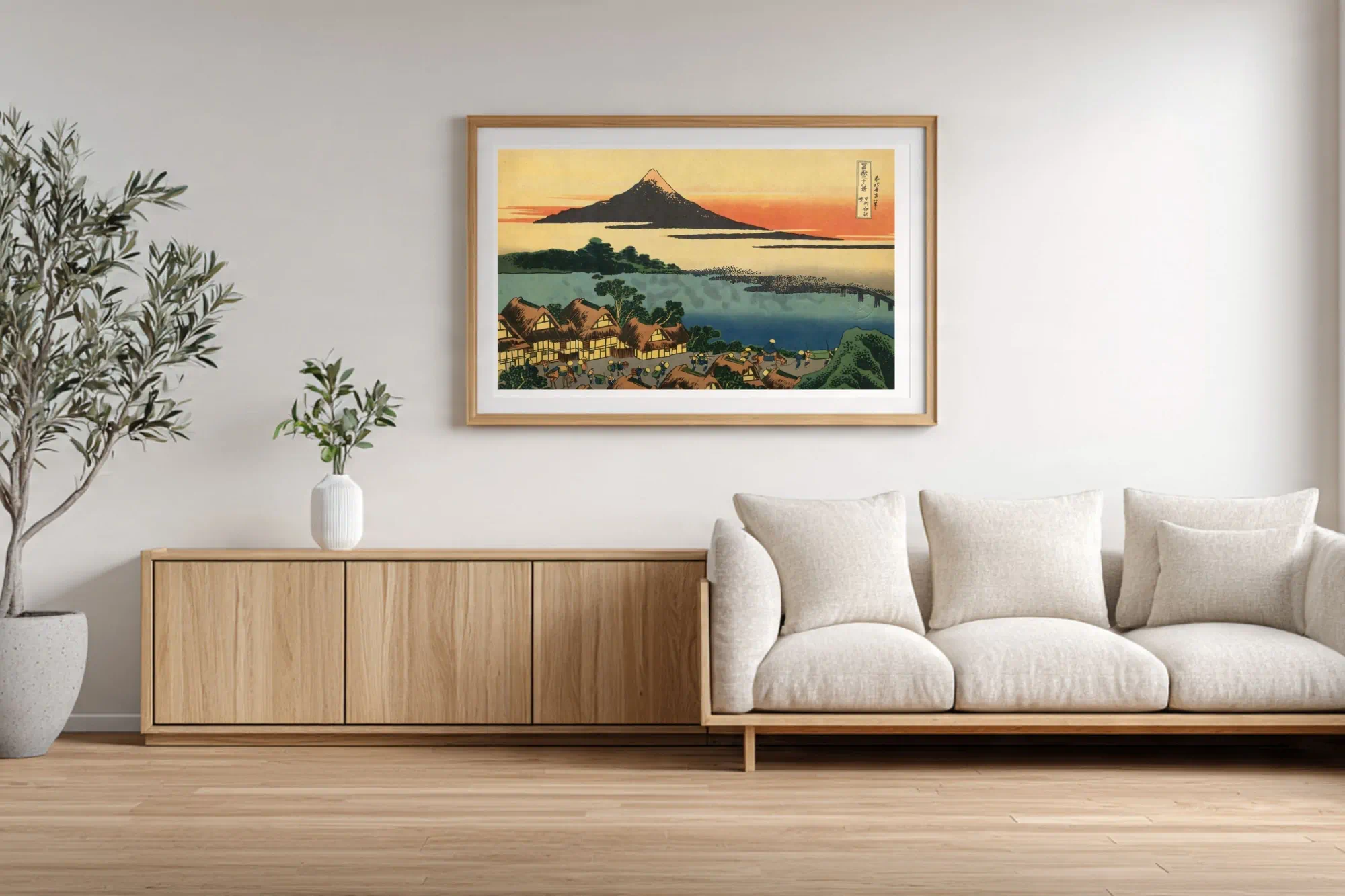
The title says thirty-six. But count the prints, and you’ll find forty-six. The subject is Mount Fuji — but the mountain is sometimes barely visible, a smudge on the horizon behind the real story. The series is called landscape prints, but many of them are secretly detailed social documents of Edo-period Japan. The 36 Views of Mount Fuji hidden details are everywhere — once you know what to look for.
Katsushika Hokusai’s landmark series, published between approximately 1831 and 1834, is one of the most studied bodies of work in art history. Yet most people who know the series from reproduction know only two or three of the most famous prints. The other forty-plus contain extraordinary details — historical, symbolic, compositional, and sometimes darkly humorous — that make the full series one of the richest archives of Edo-period life ever created.
This article walks through the series and unpacks what most viewers miss.

What Are the 36 Views of Mount Fuji?
The Thirty-Six Views of Mount Fuji (富嶽三十六景, Fugaku Sanjūrokkei) is a series of woodblock prints designed by Katsushika Hokusai and published by the Edo publisher Nishimuraya Yohachi (Eijudō). The series depicts Mount Fuji from various locations, seasons, distances, and weather conditions around the Kantō region of Japan.
Hokusai was in his early 70s when he began designing the series — an age when most people have long since retired from intense creative work. Instead, he was producing the most innovative and technically accomplished prints of his career. The series used the newly available Prussian blue pigment (bero ai) extensively, giving it a vivid, modern color palette that immediately distinguished it from earlier landscape print series.
Why There Are Actually 46 Prints, Not 36
The first paradox of the series is the most obvious: it contains more prints than its title promises. The original 36 prints were published in two batches, with the series apparently successful enough that Nishimuraya agreed to extend it. Hokusai added 10 more prints, bringing the total to 46.
The additional 10 prints are sometimes called the “back series” (ura fuji) or simply the “extra prints.” They are distinguished visually by using black outlines instead of the blue outlines used in the original 36. The additional prints tend to be more contemplative and less dramatic than some of the iconic early prints — but they contain some of the most interesting social and historical details in the full series.
In practical terms, this means: if you’ve only seen “the 36 prints,” you’ve missed nearly a quarter of the series.
Mount Fuji as a Silent Character
The most consistent hidden detail across the entire series is the role of Mount Fuji itself. In print after print, Fuji is not the subject — it’s a presence. A witness. A backdrop. The real subjects are human beings going about their lives: fishermen hauling nets, craftsmen at work, merchants on the road, pilgrims climbing toward the summit, children playing near water.
Fuji appears in different relationships to each composition. Sometimes it fills the entire upper third of the frame (as in Red Fuji). Sometimes it’s a tiny triangular form on the horizon, visible only if you look for it. In one famous print — South Wind, Clear Sky — it dominates the sky as a crimson-red pyramid. In another — Thunderstorm Beneath the Summit — it’s almost entirely hidden by clouds, visible only as a dark mass.
This variability was intentional and sophisticated. Hokusai was not painting the same mountain 46 times. He was exploring how a stable, permanent feature of the landscape interacts with unstable, impermanent human activity. Fuji was eternal; the people in the foreground were not. That contrast — eternity in the background, mortality in the foreground — is the series’ deepest theme.
Hidden Details in Five Key Prints of the 36 Views
Let’s look at specific hidden details in five of the most important prints.

The Great Wave: Where Is Fuji Actually?
In The Great Wave off Kanagawa, most first-time viewers focus entirely on the wave and the boats. Mount Fuji is often noticed as an afterthought — it’s small, white, positioned at the convergence of two curling wave crests in the upper center of the composition.
Hidden detail 1: The scale relationship between the wave and the mountain is geometrically impossible. If you calculate the actual size of a wave that large against the actual height of Mount Fuji (3,776 meters), the wave would need to be several thousand meters tall. This is not a realistic wave — it’s a mythological wave, a force of nature at cosmic scale. Hokusai was painting a metaphor, not a weather report.
Hidden detail 2: The boats in the wave’s path are not fishing boats — they are oshiokuri-bune, fast courier boats used to transport fresh fish to Edo markets. They were slender, fast, and low in the water, which is why they look so vulnerable to the wave. The fishermen are crouching in the hulls, not standing, indicating they’ve seen the wave and are taking survival positions.
Hidden detail 3: The wave’s foam tips are rendered as individual claw-like fingers. This visual motif appears in no other artist’s wave depictions of the period. Hokusai may have been deliberately evoking the popular Edo-period image of sea monsters and supernatural creatures that lived at the ocean’s surface. The wave itself may be subtly anthropomorphized — a living thing reaching for the boats.
Red Fuji: The Symbolism of Color
The second most famous print in the series, Fine Wind, Clear Morning (known popularly as “Red Fuji”), shows the mountain in early morning light, its lower slopes covered in summer green, its upper peak glowing brick red against a deep blue sky.
Hidden detail: The red color of Fuji’s upper slopes is meteorologically accurate for a specific atmospheric condition. In late summer in Japan, the snow on Mount Fuji’s upper slopes melts, revealing the reddish volcanic rock beneath. In early morning light, this rock face can glow with an intensely orange-red color for a brief period around sunrise. Hokusai was depicting a real phenomenon, not a symbolic one — but it’s a phenomenon that only someone who had observed the mountain closely over many years would know to paint.
The title, translated literally, means “South Wind, Fine Weather” — indicating the specific wind direction and sky condition that creates this effect. Hokusai was a meticulous observer of natural phenomena.
Workers, Merchants, and Pilgrims: Social History Hidden in Plain Sight
One of the most rewarding aspects of the series for historians is the detail paid to the human figures. Hokusai embedded comprehensive social documentary into what was ostensibly a landscape series.
Consider Under the Wave off Kanagawa — but more broadly, consider prints like A Sketch of the Mitsui Shop in Suruga-chō in Edo. This print shows a large commercial establishment — one of the famous Mitsui dry-goods stores — with workers on the roof arranging bolts of fabric. In the background, Mount Fuji is almost incidental. The real subject is the thriving commercial economy of Edo, the scale and sophistication of the merchant class, and the labor of the workers who made it function.
Similar social documentation appears throughout the series: craftsmen cutting timber near Fuji, tea-pickers in the countryside, travelers on the major roads, boat-builders in harbor towns. Each foreground contains a miniature documentary of how people worked, traveled, and lived in 1830s Japan.
The Print That Shows Fuji at Night
Among the 46 prints, one stands out for its unusual treatment of light: Fuji from the Back of Honmoku in Musashi Province and others show Fuji in daylight, but a handful experiment with dawn and dusk conditions. The most dramatic nighttime element appears in prints of fires and lightning.
Ejiri in Suruga Province shows travelers on a road in a fierce wind — their hats blown off, papers and scarves flying chaotically. In the background, Mount Fuji stands completely still. This contrast between the windswept, unstable human world and the unmovable mountain is one of Hokusai’s most direct philosophical statements in the series. You can almost feel the wind in the print — and you can almost feel the mountain’s indifference.
The Boats: How Big Were They Really?
Modern analysis of the boats in The Great Wave using proportion analysis relative to the wave size produces some interesting results. The oshiokuri-bune courier boats were typically about 12–15 meters long. Based on their relative size in the composition, the wave crests would need to be approximately 12–20 meters above the boat level — which actually puts them in the range of historically documented tsunami or rogue waves. Whether intentional or not, Hokusai’s proportions for the boats versus the wave may be more realistic than the wave’s impossible relationship to Mount Fuji suggests.
What Modern Oceanographers Say About The Great Wave
Physical oceanographers who have analyzed the composition of The Great Wave note that the wave structure is not entirely fantastical. The steep, near-vertical face of the wave, the curling crest about to break, and the chaotic secondary waves visible in the lower portion of the print are consistent with a breaking ocean wave caught at a specific moment of its break cycle. Hokusai appears to have studied actual wave behavior carefully — then amplified its scale to mythological proportions.
Summary: 36 Views of Mount Fuji Hidden Details Worth Exploring
The 36 Views of Mount Fuji hidden details are one of the great rewards of sustained attention to a masterwork. The series contains multitudes: social documentary, meteorological observation, philosophical meditation on permanence and transience, and pure compositional brilliance. The more time you spend with it, the more you find.
Start with the famous prints everyone knows. Then work through the rest of the 46. Each one has something that will surprise you — a figure in the corner doing something specific, a cloud formation rendered with unusual precision, a mountain that appears from an angle you’ve never seen before. Hokusai spent years with Mount Fuji, and it shows.
✦ See the Hidden Details in High Resolution ✦
ZenLine Atelier’s digital prints are optimized for large-format display — every hidden detail Hokusai embedded is visible. Download instantly, print at any size from A4 to wall-scale.